From Handwork to Household: The Long Use of Woven Baskets
Woven baskets make more sense when you follow material, form and use together, from flexible willow rods to the storage and carrying jobs they suit.
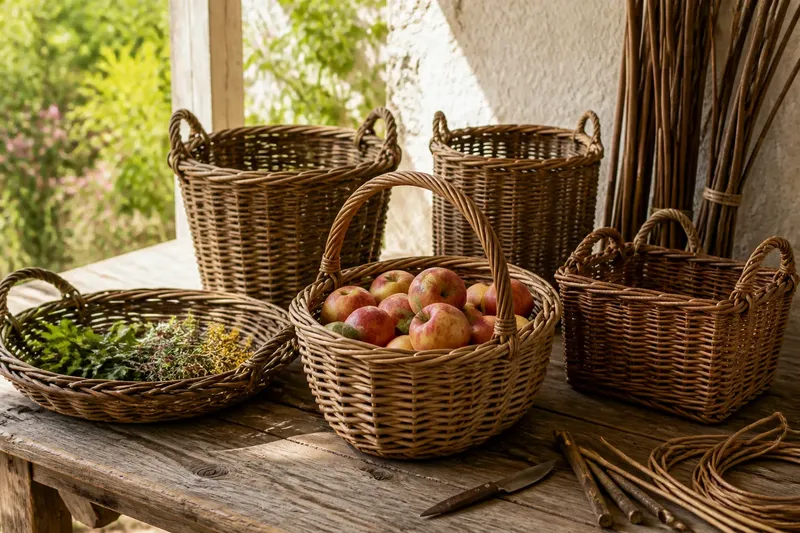
Woven baskets are easiest to understand in the hands: a willow carrier flexes slightly under a load, while a close-worked container keeps small things from slipping through. The history of woven baskets is not one story of a single shape spreading everywhere. It is a practical connection between available materials, local making knowledge and the jobs a household needed done.
Follow those connections and familiar forms become legible. A handle, an open weave or a reinforced base is not merely decoration; each can reflect how a basket was carried, what it held and how its maker expected it to be used. The numbered points below trace those links without treating any one design as universal.
1. Materials set the first limits
Basketry begins with what can be gathered, prepared or obtained nearby. Willow, hazel, rush, grasses, reeds, split wood and other plant fibres each behave differently. Some can be bent into long ribs; others are better suited to fine weaving or binding. A maker’s choice depends on the material’s length, flexibility, strength and condition, as well as the intended object.
Willow rods, for instance, can form a sturdy framework when they are pliable enough to bend without splitting. Rushes and grasses can be woven into lighter forms, though their thickness and texture affect how close the weave can be. In places where suitable plants are scarce, makers may work with purchased or traded materials instead. The craft therefore reflects both local ecology and the routes through which materials move.
Preparation matters as much as the plant itself. A material may need sorting, drying, soaking or splitting before it is ready to weave; the appropriate treatment depends on what it is and how it will be used. Differences in preparation can change the colour, feel and ease of handling. They also help explain why two baskets made in similar forms may look quite different.
2. The weave records a maker’s decisions
A woven basket is built from parts that work together. Upright stakes or ribs provide a framework, while weavers pass around them to build the sides. A base may be woven first and extended upwards, or formed around a separate framework. The precise method varies, but the maker must manage tension so the walls hold their shape without becoming brittle or uneven.
Spacing is a practical choice. A broad, open weave can suit bulky items that do not need to be contained closely; a tighter one can keep smaller contents from escaping. A narrow weave also uses material differently and takes more careful placement. Neither approach is automatically better: the intended contents, weight and handling determine which makes sense.
Edges and joins reveal another layer of skill. A finished rim can lock loose ends in place and make the upper edge easier to grip. A handle must meet the body in a way that suits the expected load, while a base needs enough support to sit or move as intended. These details may be quiet, but they distinguish a basket made for regular use from a form meant chiefly to be displayed.
3. Household jobs shaped familiar forms
People have used baskets to gather, carry, sort and store. A broad, shallow form can make it easier to see and reach contents; a deeper container can hold more without spreading items across a surface. A handled basket is convenient for carrying, while a sturdy open container may be useful beside a work area. These are broad relationships between shape and task, not fixed regional rules.
Household baskets often moved between tasks. One might carry produce in from a garden, hold kindling near a hearth or keep sewing materials together. The same object could be useful in several settings, particularly when storage space was limited. Its shape reflects a compromise: useful enough for more than one job, but formed with some tasks in mind.
Say a household needs to carry apples from a garden and then keep them near a cool pantry wall. A medium-depth basket with a stable base and handholds could make that movement manageable, while an especially open weave might let smaller fruit press against the gaps. The household could choose a closer weave or line the basket with clean cloth, then place it where air can circulate. The expected result is fruit contained for carrying and easier to inspect during storage, though the basket itself does not replace suitable food-storage conditions.
4. Shape speaks to carrying and handling
Handles alter how a basket meets the body. A single arched handle can be lifted by hand; paired handles may allow a different grip or the use of both hands. A basket carried against the hip, held in front or set down often will need to balance differently. The shape and position of its handles make sense only when considered alongside its likely contents and route.
Depth and width also affect handling. A wide basket can make access easy but may be awkward in a narrow passage. A deeper one can keep objects gathered, though reaching the bottom may be less convenient. Makers and users weigh these ordinary trade-offs through practice, and household habits can preserve a useful form even when the original task changes.
Wear offers clues, too. A polished handle, softened rim or darkened base may suggest frequent contact, though wear alone cannot establish exactly who used a basket or for what. Repairs can be equally revealing: a reinforced corner or replacement binding shows that continued service mattered enough to justify further work. Such evidence points to use and care, not a definitive account of origin.
5. Making traditions travel and change
Basket-making knowledge can pass through families, workshops, markets and observation. A learner may first help sort materials or prepare rods, then practise parts of a weave before attempting a complete piece. Skills are held in the hands as well as in words: tension, rhythm and the response of a damp or dry fibre are learned through repeated attention.
Traditions are not sealed within one village or landscape. Makers can adapt a form to a different material, borrow a useful detail or respond to what buyers ask for. Trade can introduce unfamiliar fibres and finished baskets, while changing household routines can alter which objects people need. A basket that resembles one made elsewhere may reflect shared practical demands rather than a single origin.
For that reason, names and shapes should be handled carefully. The same everyday term may refer to different objects in different communities, and similar-looking forms may have separate making traditions. When identifying a basket, note what can be seen first: material, weave, construction, repairs and signs of use. A local craftsperson, museum catalogue or knowledgeable community member may help place those observations in context.
6. Household care keeps the object in view
Care begins with the material and the basket’s condition. Dust can often be lifted with a soft brush, while persistent dirt or loose fibres call for a gentler approach than a hard scrub. Avoid soaking an old or fragile basket simply because plant material was used to make it; moisture can affect fibres, joins and shape. For an heirloom or delicate piece, ask a conservator or experienced basket-maker before attempting treatment.
Storage matters because a basket can be distorted by pressure or become brittle if neglected. Keep it supported in its natural shape, away from damp conditions and from places where it will be crushed under heavier objects. If it is still used, match the contents to its apparent strength and keep sharp or wet items from damaging the weave. The maker’s material and construction are more useful guides than assumptions about what every basket can tolerate.
Repair can extend use, but it need not conceal the object’s history. A loose strand may be a simple matter for a skilled maker, while a weakened handle or failing base deserves closer attention before the basket carries anything heavy. Repair choices should respect both function and value: a working household basket and a fragile inherited piece may call for different treatment.
What do woven baskets tell us?
Can a basket’s shape identify where it was made?
Shape can offer a clue, but it rarely settles the question on its own. Materials, construction, local names, trade and later repairs all matter, so avoid assigning a basket to a region from outline alone.
Why do baskets use different weave patterns?
Weave patterns balance containment, strength, flexibility and the amount of material required. The right choice depends on the basket’s job and the properties of the fibre, not on a universal ranking of patterns.
Were household baskets made for only one task?
Some forms were closely suited to a particular kind of work, while others moved between carrying, sorting and storage. A basket’s wear and dimensions can suggest its use, but may not reveal every task it served.
How should an old basket be identified?
Record its materials, weave, base, rim, handles and repairs, then compare those details with reliable local knowledge. If the basket is fragile or valuable, seek a conservator or specialist before cleaning or repairing it.
Read the basket through its working life
To understand woven baskets, begin with the visible choices: what the maker could weave, how the structure holds together and what the form allows someone to carry or store. Add the basket’s wear and repairs, and a working life starts to come into focus without requiring a claim that one design belongs to every place.
The history of woven baskets is often quiet and domestic. It sits in the bend of a handle, the spacing between strands and the choice to mend a rim instead of replacing the whole object. Look closely at those details, and a household tool becomes a record of material knowledge shaped for everyday use.