The Local Food Label Is Not the Whole Story
A local food label can point you towards nearby producers, but these questions help you check where an ingredient came from and how it reached you.
What does a local food label actually tell you? A local food label may name a farm, village or region, but a place name alone cannot explain how an ingredient was grown, processed or brought to market. The useful response is not to dismiss the label or treat it as a full account: match your questions to the food, the wording and the decision you need to make.
A local food label points to a place, not a complete journey
“Local” can refer to where something was grown, where it was made, where a business is based or where it was sold. Those are different claims. A jar labelled with the name of a nearby village might contain fruit grown elsewhere, while a cheese made locally might use milk from farms across a wider area.
Labels also have limited space. A producer may use a place name to help customers identify a business or its market, without claiming that every ingredient, package or stage of processing is local. Read the wording as a clue to ask about, not a complete description of the supply chain.
There is no single distance that every shop, farm or customer means by “local”. A village market may favour nearby farms; a regional food group may include producers across a broad area. If the exact boundary matters to you, ask what the seller means by the term rather than assuming it is shared.
Choose questions that fit the situation
The right question depends on what you are trying to decide. You might want to know the growing area, support a nearby maker, understand a processing choice or avoid an ingredient from a particular source. Start with that priority, then ask for the detail that could change your choice.
- If you want food grown nearby: ask where the crop or animal was raised, rather than only where the business is based.
- If you want to support a local maker: ask where the food was processed and whether the producer makes it on site or contracts that work elsewhere.
- If you are comparing seasonal produce: ask whether it was grown outdoors, in a heated structure or brought in from another place. The answer can explain why a local product is available when you did not expect it.
- If you care about the route to market: ask who sold or packed the food and how it reached the shop or stall. A local retailer and a local grower are not necessarily the same business.
- If you need information for an allergy or other health concern: use the ingredient and allergen information, and ask the seller or producer for clarification. A place name does not provide a safety answer; consult a qualified health professional where personal advice is needed.
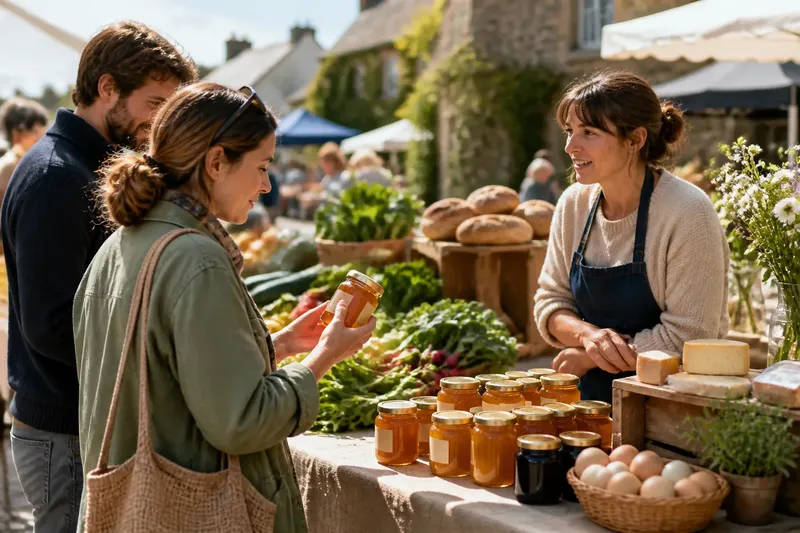
Imagine you are choosing between two jars of honey at a village market. One names a nearby apiary, while the other says only “packed locally”; asking where the honey was produced would help distinguish the claims without assuming that either label is misleading.
Ask about growing when origin matters
For vegetables, fruit, grain and meat, ask where the primary ingredient was grown or raised. A farm name can help, but a farm may work land in more than one parish or source feed, seed or young plants from elsewhere. If those details matter to your decision, ask about the particular part of production you care about rather than treating “from this farm” as an answer to every question.
For seasonal food, availability alone is not a reliable guide to growing conditions. A local greenhouse, a storage crop and produce brought in from another growing area can all appear on a local shop’s shelves. Ask whether the food was grown outdoors or under cover, and whether it was stored or transported before sale.
These questions are about context, not a ranking. Different growing methods suit different crops and producers, and the label may not set out every detail. If a seller cannot answer, you can decide whether the information is essential or whether the broad origin claim is enough for your purpose.
Separate where food is made from where its ingredients come from
Prepared foods often have more than one meaningful location. A local bakery may make bread from flour milled elsewhere; a village cheesemaker may turn milk from several farms into cheese on site. “Made here” can accurately describe the work while leaving the ingredient origins open.
Ask which stage the place name describes: growing, milling, cooking, preserving, packing or selling. For a chutney, for instance, you might care most about where the fruit was grown; for a loaf, you might be asking about the bakery and the flour mill. Narrowing the question makes the answer easier to use.
Processing can also happen through another business. A small producer might send fruit to a shared kitchen or use an outside packer, while still developing and selling the finished product locally. If local production is your priority, ask where the actual making takes place and what work the named business does.
Read a market label alongside the seller’s answer
At a farm shop, market stall or village food event, the person selling an item may know the producer directly, or may be reselling goods from several suppliers. Check the sign and packaging first, then ask who made or grew the food if that is not clear. A direct, specific answer is more useful than a broad assurance that something is “from around here”.
For packaged food, look for the named business, ingredient list, origin wording and any distinction between “produced”, “prepared”, “packed” and “distributed”. Those terms can point to different stages. If a label names a local firm but gives no ingredient origin, it may identify the firm without locating every component.
Where wording is governed by a product label, producer instructions or local rules, check those sources for the exact meaning rather than relying on a general interpretation. This matters especially for protected regional names or claims tied to a formal scheme, whose requirements can be more specific than everyday use of a place name.
Common questions about local food labels?
Does “made locally” mean all the ingredients are local?
No. It normally points to a place associated with making the food, but it does not by itself locate every ingredient. Ask where the main ingredients were grown or produced if that is what you need to know.
Is a farm name enough to confirm where an ingredient was grown?
It is a useful starting point, but it may not show which land or supplier provided the particular ingredient. Ask whether the named farm grew it and whether any part came from another source.
Should I trust a local food label if the seller cannot answer every question?
Not necessarily as a complete account, but uncertainty does not by itself prove a claim is false. Decide which fact matters to you, ask for that fact, and choose whether the information available is enough for your purpose.
How can I tell whether “local” has a defined boundary?
Look for a stated area, membership scheme or producer description that explains the boundary. If none appears, ask the seller what “local” means in that context; different businesses may use the word differently.
Make a choice without asking for every detail
You do not need a full account of every farm, processor and delivery route to buy food thoughtfully. Choose one or two details that could affect your decision: the growing place, the maker, the production method or the seller’s relationship with the producer. If the answer is clear enough, use it; if it is not, compare another product or decide whether the missing detail matters.
The local food label is most useful when treated as an opening point for a proportionate question. Ask about the stage you care about, listen for a concrete place or process, and keep “grown here”, “made here” and “sold here” distinct. That gives a place name context without demanding that one short label tell the whole story.